Slowdown by design
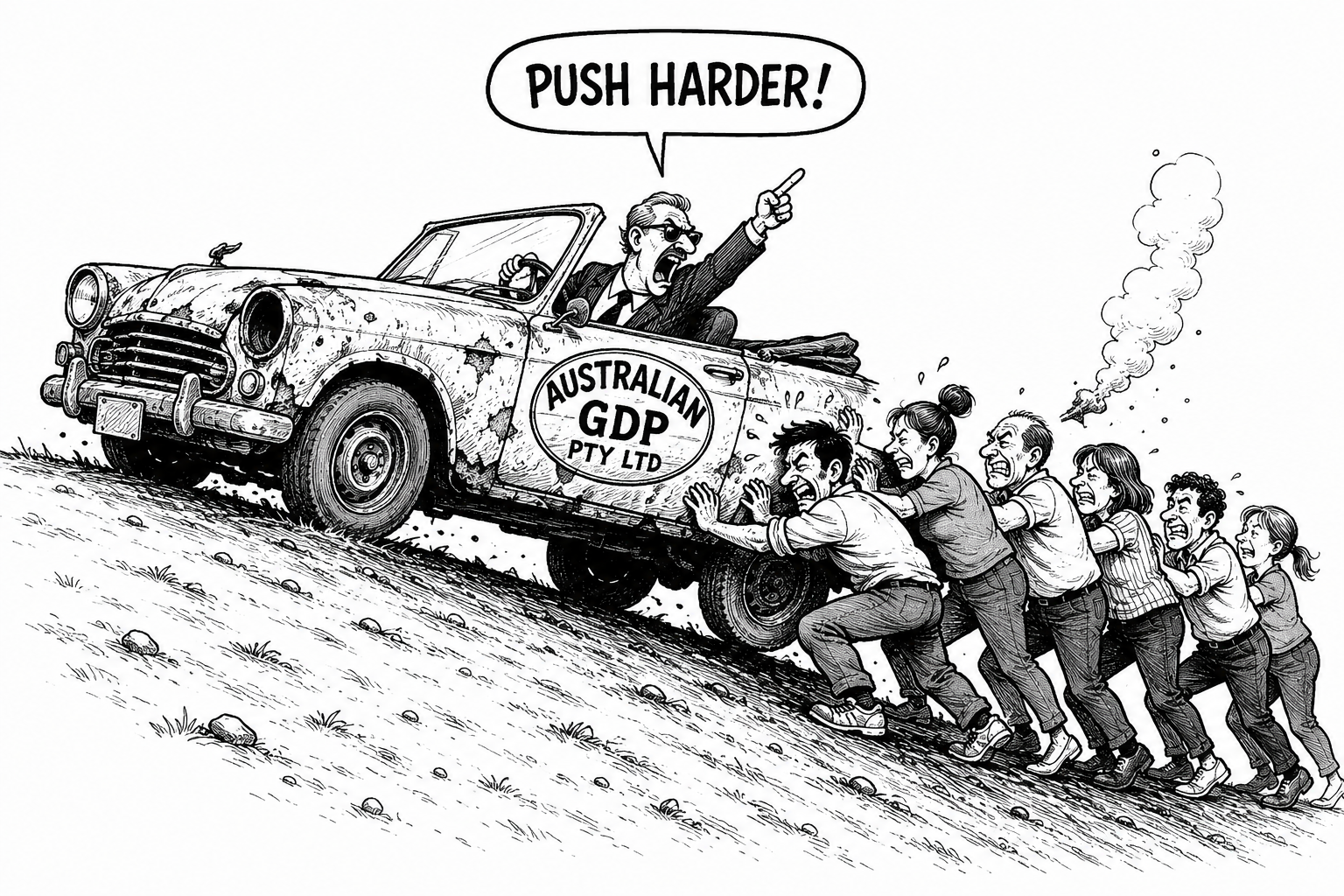
The Reserve Bank has confirmed Australia’s economy is slowing down and, before anyone starts panicking, would like you to know that’s entirely intentional.
GDP growth limped in at 0.3 per cent for the March quarter as higher interest rates continue doing their job; making Australians think twice about spending money they no longer have.
Inflation remains above target, so the cure is the same – make borrowing expensive, slow the economy down and hope nobody notices the patient looks a bit pale.
According to RBA heavy, Michele Bullock, suggestions of stagflation are misguided arguing Australia is experiencing a supply shock rather than the economic horror show of the 1970s. AAP has more detail.
House prices discover gravity
While Michelle Bullock appears untroubled by the prospect of falling property values, the market appears to have remembered that prices are supposed to respond to interest rates.
Commonwealth Bank has sharply downgraded its housing forecasts, now expecting national dwelling prices to be essentially flat in 2026 after previously forecasting growth. Sydney and Melbourne are expected to do the heavy lifting on the way down, with potential price falls significant enough to leave some recent buyers staring nervously at their mortgage statements and wondering whether “equity” was just a marketing slogan.
The shift reflects a combination of higher interest rates, weakening sentiment and housing policy changes that have injected uncertainty into the market. For years Australians were told property only goes up. Now the message appears to be that property still goes up—just perhaps not immediately, continuously or by double digits every year. Reality has entered the chat.
The vanishing cheap mortgage
Remember when lenders competed aggressively for borrowers? Neither do the borrowers anymore.
According to mortgage market data, home loan rates below 5.75% are becoming increasingly rare. Average owner-occupier variable rates have climbed to around 6.65%, while fixed rates remain stubbornly elevated. What was once a crowded field of competitive offers is rapidly becoming an exclusive club with very few members.
The banks, naturally, explain this as a reflection of funding costs and market conditions. Borrowers may describe it differently. To many households, the mortgage market increasingly resembles airline pricing: everyone advertises bargains, but somehow you never seem to qualify for one.
The mortgage hunger games
As affordability worsens, a radical idea has emerged: a two-tier mortgage system in which your interest rate is determined by how much you earn. Low-income earners get a lower interest rate with the gap being picked up by the government. You pay the full rate if, or when, you are earning more than the threshold income.
Critics might observe that once governments and financial institutions start deciding who deserves cheaper money, the paperwork will breed faster than rabbits on a fertility program.
Still, the proposal highlights an uncomfortable truth. Interest rate increases may be mathematically equal, but they don’t feel equal. A household earning $250,000 and one earning $90,000 experience the same rate rise rather differently. One cancels a European river cruise. The other cancels electricity. Want to read more? You’ll find a further discussion at realestate.com.au
Death by a thousand fees
Australians paid an estimated $4 billion in bank fees over the past financial year. Four billion dollars. That’s a lot of money for the privilege of having your own money held hostage by a financial institution.
Banks argue that fees cover services, infrastructure and operational costs. Customers often struggle to identify which service they’re paying for when charged to receive a paper statement nobody requested or to access funds that already belong to them.
The genius of banking fees is their invisibility. Nobody wakes up excited to pay them, yet collectively they represent one of the most reliable revenue streams in Australian finance. It’s like a gym membership for your bank account: you keep paying and hope you’re getting something in return.
Lending like there is no tomorrow
While housing attracts most of the headlines, business lending continues to grow. ANZ recently led the major banks in monthly business lending growth, signalling that corporate Australia is still willing to borrow despite elevated rates.
That’s encouraging if you’re looking for evidence of economic resilience. Less encouraging if you’re hoping inflation pressures might disappear quietly without further intervention from the Reserve Bank.
Banks love talking about supporting business growth. It’s one of the few forms of lending where nobody expects them to apologise afterwards. Read more at Broker Daily.
We’re here to help
NAB CEO Andrew Irvine has reassured customers that the bank is there to help during difficult economic conditions.
Banks always make these announcements during periods of financial stress. Nobody ever sees a press release saying: “Times are great. We have decided not to help.”
To be fair, hardship programs matter and can genuinely assist struggling customers. The cynic merely notes that these messages tend to arrive shortly after a rate rise and shortly before another quarterly earnings report. Here’s the NAB version.
Nvidia builds the future
Away from Australian mortgages, but gobsmacking enough to notice and report on. Nvidia, the company whose computer chips run artificial intelligence platforms plans to invest a staggering $150 Billion a year in Taiwan where the semi-conductors vital to the operation of AI chips are made.
While Australian households debate how to afford a home loan, the global technology sector is spending hundreds of billions of dollars teaching computers to answer questions and generate cat pictures.
History may judge AI as the next industrial revolution. Or the world’s most expensive autocomplete function. Either way, somebody is making money from it—and it probably isn’t your mortgage broker.
The week in one bitter pill
For all the talk of reform, innovation and economic management, the week ended much as it began. Households are paying more, banks are earning more, governments are promising more, and investors are worrying more. The only thing moving faster than artificial intelligence appears to be the speed at which ordinary Australians are being asked to adjust their expectations.