In the past week, several online finance publications have excitedly jumped on the ING band wagon promoting what one of them describes as the “biggest change in 18 years”: The bank’s “hefty” and “market leading” six percent interest rate on savings accounts.
ING’s head of retail, Jennifer Davies, has reportedly said that this “represents the biggest evolution of our savings proposition in almost two decades”.
Six per cent on a savings account sounds like a major opportunity.
It’s not.
Marketing Hyperbole
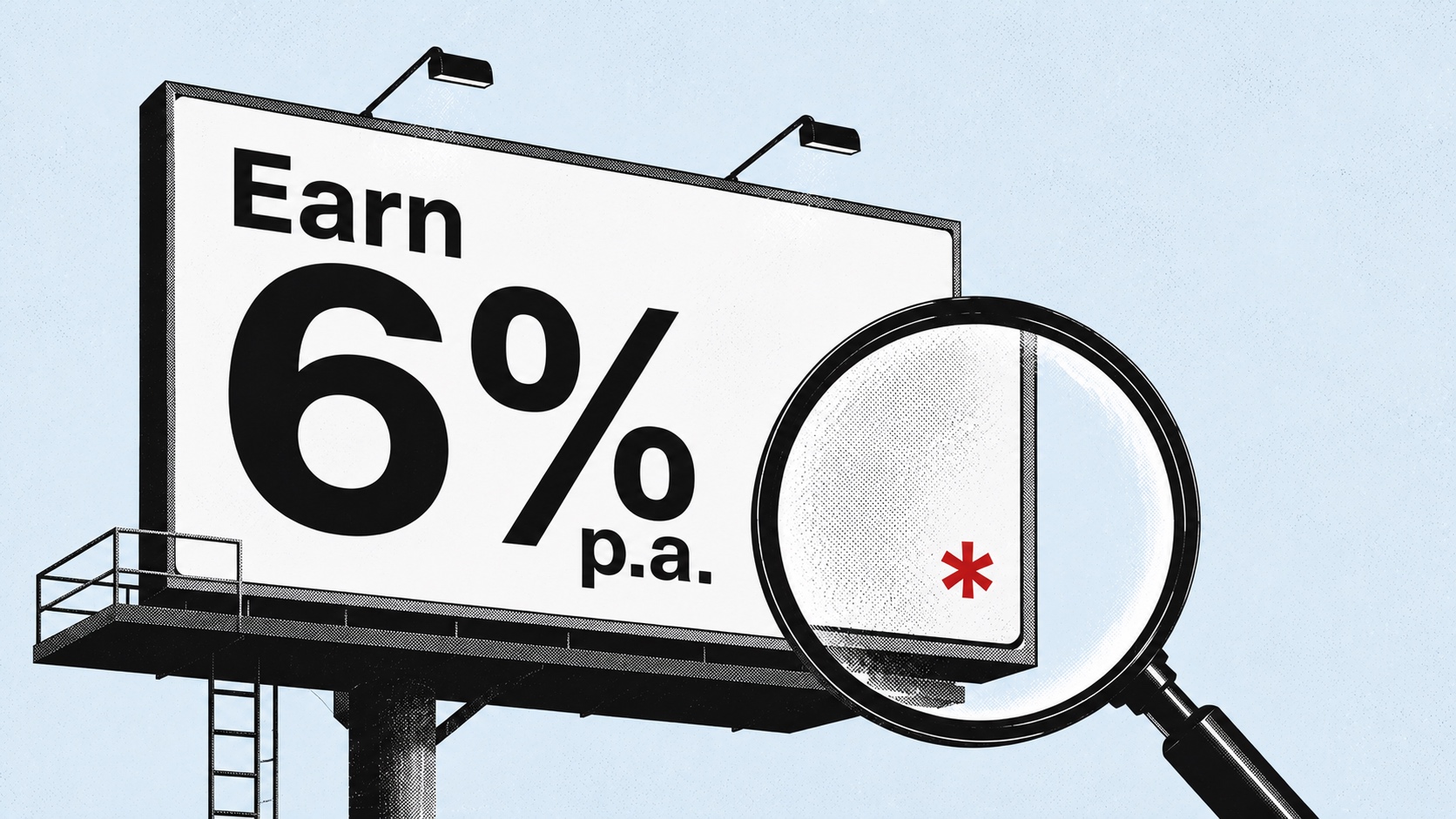
The reality is that the six per cent rate lasts just four months. You’ll only discover this when you have waded through a mountain of marketing hyperbole and reached the asterisk!
The asterisk reveals that, after four months, six per cent dips to 5.4%, which is pretty much what everyone else offers. To earn even that you must top up your account by $100 a month otherwise the rate falls back to a measly 2.25%.
If this is, in fact, the “biggest evolution” of ING’s savings proposition, its bankers have endured very dull lives.
Why Whinge?
Why whinge? Why all the noise? Everybody does it. The biggest number gets the headline. The conditions get the asterisk. If ING is in the sin bin, it’s not going to get lonely.
This type of promotion has become the default language of financial marketing. Bigger headline. Smaller qualifications. Longer conditions.
Twenty years ago, a savings account advertisement simply said: We pay 5%.
Today it says: Up to 6%
- For four months
- With bonus conditions
- When linked to another account
- On balances up to X
- Subject to Y.
The product isn’t any better than it was 20 years ago, but the marketing is. It’s much better.
The marketers know that customers will lock onto a great headline rate like seagulls onto a bag of chips. The conditions become secondary. Almost an afterthought.
Harder to Compare
A recent inquiry by the ACCC found many customers fail to earn advertised bonus rates on savings accounts because the conditions are too complicated. Banks also know many customers are unlikely to move once the promotional period ends.
The result is a financial marketplace where products aren’t necessarily becoming better, they’re becoming harder to compare. Consumers are expected to behave like full-time financial analysts, forever chasing introductory rates, cashback offers, bonus points and special deals before they quietly disappear.
Legitimate
It’s not illegal. Most of it is perfectly legitimate. But there’s a world of difference between selling a good product and selling one that’s only good for four months.
Perhaps it’s time the industry rediscovered an unfashionable marketing strategy: tell people what they’ll get, not what they could get under ideal circumstances.
Six per cent is a good headline, but 5.4 per cent with conditions is the product.
In Case You Missed It…
NAB’s Drought Warning: Is the well running low at National Australia Bank? It reports that loan applications in the June quarter plunged 11% and 8% of loans are on a watch list.
Bank Fees Get The Boot: The ACCC has told banks to stop waiting for struggling customers to ask for cheaper accounts and start moving eligible people onto them automatically. About time too.
CBA’s Broker Blues: Mortgage brokers have delivered Commonwealth Bank a report card it won’t be sticking on the fridge, praising its technology while questioning its commitment to the broker channel.
Windfalls Become Woolworths: Forget holidays or handbags. More than half of Australians say an unexpected $500 would disappear straight into groceries and household bills. Suddenly, consumer confidence turns to survival.
Stress Heads Uptown: Mortgage stress is no longer confined to the mortgage belt. It’s spreading into some of Australia’s wealthiest suburbs as higher rates catch heavily indebted households.
Help To Buy… Slowly: Teachers Mutual has become the third lender to join the Federal Government’s Help to Buy scheme, expanding access to homes but leaving plenty of room for more competition.
The Beer Index: Economists have another quirky way of measuring the cost of living. This one tracks five beers and two packets of cigarettes. Melbourne has just claimed the unwanted world title.
Well, that’s it for another week. If you enjoyed this week’s edition, please forward it to someone who enjoys finance without the fluff. Better still, tell them to subscribe.
The bigger our audience, the more independent we can remain—and the more asterisks we can point out before someone hides them in the fine print.
See you next week.