Hedge funds death ride banks
For years betting against Australian banks has been the financial equivalent of standing in front of a freight train and announcing you’re feeling lucky. The banks kept making money, house prices kept climbing and every warning about valuations was treated like a conspiracy theory from a bloke yelling at crows in a Bunnings car park.
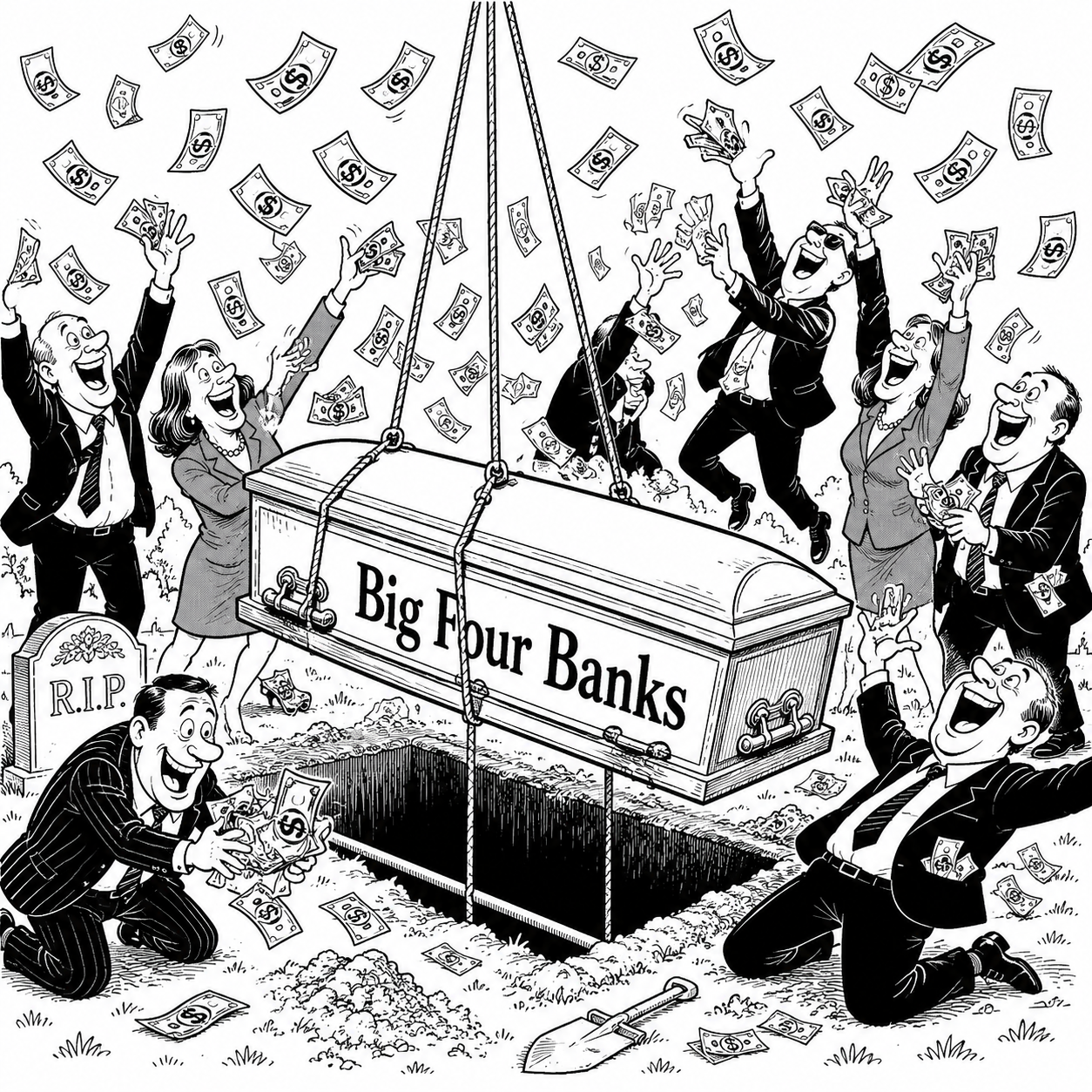
Now hedge funds have amassed a record $11 billion in short positions against the big four banks. Commonwealth Bank is carrying the largest target on its back, with investors arguing valuations have become detached from reality and that a softer housing market could expose some uncomfortable truths. Importantly, most analysts aren’t predicting a banking apocalypse. They’re simply suggesting the market may have become a little enthusiastic.
Unfortunately for millions of Australians, their super funds are heavily exposed to bank shares, meaning everyone gets a front-row seat if the correction arrives. Get the full story here
Feeding seagulls
Nothing says confidence in the economy quite like lenders scrambling to cut rates before the Reserve Bank has even spoken. With markets increasingly expecting the RBA to pause at its upcoming meeting, a growing number of lenders have started trimming mortgage rates in anticipation.
The logic is straightforward. Economic growth has slowed, unemployment has edged higher and the RBA is trying to work out whether inflation remains public enemy number one or whether it has already punched the economy hard enough. Banks are attempting to look generous without becoming too generous. It’s a delicate balancing act between helping customers and protecting profit margins, a bit like feeding a seagull while keeping all your chips. Canstar has the who’s who.
The contrarians
Independent Australia has taken aim at what it sees as a media obsession with talking Australia into a recession that doesn’t exist. The article argues that sections of the press continue portraying the economy as a disaster zone despite official data showing ongoing growth.
The piece suggests recession headlines have become less about economics and more about politics. According to the author, some commentators seem deeply disappointed whenever economic data fails to cooperate with their preferred narrative. It’s a strange business model. Most industries celebrate good results. Economic reporting often treats them as an administrative error requiring immediate correction. Visit Independent Australia to hear the other side.
Borrow now, regret later
Australians are increasingly turning to personal loans as cost-of-living pressures continue squeezing household budgets. What was once borrowing for a holiday or a new car is increasingly becoming borrowing to keep the household wheels attached. The Australian Bureau of Statistics reports that personal loans issued by banks reached a record $5.1bn in the first three months of 2026
It turns out that when everything costs more, people either spend less or borrow more. Guess which option keeps the banks happier?
Wheels of misfortune
ASIC has won a court case against a south-west Sydney car dealership and its former director after the Federal Court found they engaged in unlicensed lending and charged unlawful fees to customers. The court found that Diamond Wheels Pty Ltd, trading as Lansvale Motor Group, and Keo Automotive Pty Ltd arranged finance for vehicle buyers without holding the required Australian Credit Licence and imposed fees that should never have existed in the first place. A further hearing on penalty will be held in August.
The ruling is another reminder that some corners of the motor trade still treat consumer credit laws as more of a polite suggestion than a legal requirement. Buying a used car is already one of life’s more dangerous financial adventures. You walk in hoping for reliable transport and leave wondering why the paperwork is thicker than a Tolstoy novel. See ASIC’s explanation here.
Taxing the dream
Economists have spent years describing stamp duty as one of the dumbest taxes in Australia. It punishes people for moving, gums up the housing market and hits buyers with a bill roughly equivalent to a small family hatchback just when they’ve emptied every pocket.
So, full marks to the ACT government for being the first Australian jurisdiction to abolish stamp duty for all first-home buyers, a move that has won support from housing reform advocates. From July 1, first-home buyers in the territory will no longer pay the tax regardless of income or property value, with concessions also extended to pensioners, eligible NDIS participants and some returning buyers.
Brokers rule
Mortgage brokers have reached a record market share, settling 81 per cent of all new residential home loans written in Australia. The latest figures highlight the continuing dominance of the broker channel as borrowers increasingly rely on intermediaries to navigate a mortgage market featuring dozens of lenders, hundreds of products and enough fine print to wallpaper Parliament House.
It’s one of the great ironies of modern banking: financial institutions spend billions building brands, apps and advertising campaigns only to discover customers would rather ask a broker which bank to choose. In most industries that’s called losing the sales process. In banking it’s apparently called distribution strategy.
The last word
Hedge funds think the banks are overpriced. Banks think borrowers are underpriced. Journalists argue about whether we’re in trouble while households add more debt. Taken together it’s a familiar picture; Australia’s financial system remains exactly what it has always been: a highly sophisticated machine for converting uncertainty into headlines and household debt into shareholder returns.