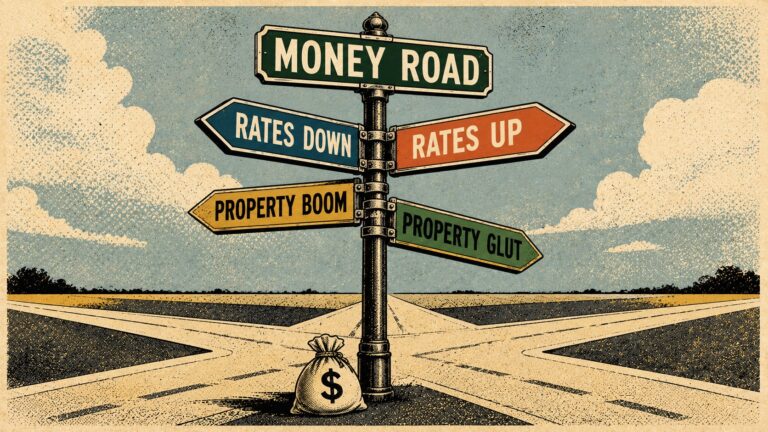

Borrowers pffft….
Home loan borrowers are disappearing in worrisome numbers according to the the four majors which have reported sharp falls in loan applications since the May Federal Budget: Westpac down 20 per cent, CBA down 15 per cent, ANZ down 12 per cent and NAB down 15 per cent. Together, the big four account for almost three-quarters of Australia’s home lending.
Some mortgage brokers are reporting their business has fallen by more than half. Borrowers have the jitters and are waiting to see where prices go while investors are sit on their hands The exception has been a rush of SMSF applications before the new ban on borrowing for residential property took effect on August 10.
Housing Earthbound
Property owners have spent years watching prices rise whilst treating their homes like a second super fund. Now, the music has stopped with ANZ forecasting capital city prices could fall 10.6 per cent from peak to trough, including a 14.5 per cent fall in Sydney and 12.8 per cent in Melbourne.
The forecasts are just that, forecasts, and ANZ expects prices to recover through 2028, helped by anticipated interest rate cuts and Australia’s housing shortage. Brisbane, Adelaide and Perth are forecast to fare better, although all three have enjoyed enormous gains since 2021. The good news for buyers is that falling prices might finally make housing slightly less ridiculous. The bad news for sellers is that they may have to stop calling the agent every Tuesday to ask what the house is worth.
Read more at realestate.com.au
Sellers Lose Swagger
For years, buyers have been told to act quickly because someone else was always about to make an offer. That script is changing, with total housing supply across the capital cities reaching a seven-year high and July producing a record number of new listings for the month.
Sydney, Brisbane and Canberra are giving buyers more room to negotiate, while Perth listings have jumped 52.7 per cent over the year. Adelaide and Perth remain stronger markets, and distressed sales are still historically low. So this isn’t a mortgage-stress fire sale. It is simply a market where sellers have discovered buyers can say “I’ll think about it” without immediately being trampled by twelve other bidders.
Eleven Billion Reasons
CBA has reported a $10.98 billion full-year profit while simultaneously warning that mortgage demand is slowing and credit growth is likely to ease. Chief executive Matt Comyn says the weakest point appears to have passed and expects mortgages applications to grow 4 to 5 per cent over the next year.
The bank’s cash profit rose 7 per cent and shareholders will receive a higher dividend. Loan arrears remain relatively low, although CBA has increased its loan impairment expense by 9 per cent to $788 million. So, for households and borrowers it’s a slowdown. For CBA shareholders, apparently, it’s Thursday.
Bendigo’s Cyber Fail
You can spend millions improving your technology and still discover that someone forgot to lock the back door. The Australian Prudential Regulation Authority has hit Bendigo Bank with an $8 million penalty for cyber security failures dating from 2020 to 2023, relating to its former Alliance Bank business.
A major cyber incident in March 2023 compromised 250 accounts and resulted in $140,000 being misappropriated. Bendigo says affected customers were fully reimbursed. The bank is now investing heavily in technology and has entered outsourcing arrangements as it attempts to strengthen its systems. It seems even banks occasionally discover that “digital transformation” is considerably easier to put in a PowerPoint presentation than into a working computer system.
Revolution?
The Big Four have spent years becoming very comfortable with their position. Now, that Revolut has received its Australian banking licence and can accept deposits protected under the Financial Claims Scheme there is hope it will give the Majors a run for their money.
Revolut already has more than one million Australian customers and more than 75 million globally. While it is yet to offer home loans, it offers a range of digital and international services that traditional banks have been slower to develop. The question is whether Australians will trust a digital challenger with their savings and salaries. If the answer is yes it can only be good for customers.
The Bottom Line
The housing market is cooling, but it hasn’t collapsed. Buyers have more choice, brokers have less business, banks are fighting harder for customers and CBA is still making nearly $11 billion.
Which rather neatly sums up Australian finance: things can be going badly for borrowers while going remarkably well for the people lending them the money.