Banks Blink First
Eighteen lenders have cut variable mortgage rates since the RBA’s last hike in May — a rate war nobody at the Reserve Bank actually declared. AMP Bank went hardest on fixed rates, slashing up to 0.50 percentage points, more than double the average cut of 0.22 percentage points recorded across five lenders.
Canstar’s Sally Tindall called it competition, not victory over inflation — a timely reminder given APRA’s March data shows arrears creeping up and investor debt-to-income ratios above six times jumping from 8.2 to 10.8 per cent in a year. Westpac remains the lone major bank still betting on a rate hike come August. Somebody’s wrong, and mortgage holders are the ones who’ll find out which.
The House Always Wins
The premium for a detached house over an apartment has hit a record 53.5 per cent, with Cotality data showing house values have climbed 34.8 per cent over five years against a comparatively modest 17.1 per cent for units. In Sydney, that’s the gap between a $1.56 million house and an $898,623 unit — $657,635, or 73.2 per cent, which is roughly the cost of a second, smaller house.
Cotality’s Gerard Burg says affordability pressure is finally nudging buyers toward apartments, and Brisbane is leading the charge, with units up 94 per cent since 2021 against 78 per cent for houses. Three interest rate hikes did nothing to close the gap. Apparently, Australians would rather owe a fortune for a backyard than a slightly smaller fortune for a balcony.
The Bank of Mum and Dad Calls In Security
The share of first-home buyers using a family guarantee has nearly halved, falling from 6.41 per cent in February to 3.86 per cent in June, according to mortgage brokerage Loan Market. Blame the federal budget’s changes to capital gains tax and negative gearing, which appears to have quietly wrecked the investment-property strategy many parents were using to fund the Bank of Mum and Dad in the first place.
Reportedly, parents are now asking how to protect themselves, not just how to help their kids — a fair question when a guarantee that once tied up the family home for a year or two could now run much longer. The Bank of Mum and Dad is estimated to be worth $35 billion nationally, but just like everyone else it is tightening lending standards.
The SMSF Sprint
Self-managed super funds have about a month left to sign a contract borrowing for residential property is banned. The FBAA’s Leo Gagic says the reforms — passed, he claims, without industry consultation — have left brokers and borrowers scrambling and warning of “confusion and distress” in the market. The Treasurer, for his part, points out SMSFs account for under 1 per cent of residential property borrowing overall, which rather undercuts the panic.
Commercial SMSF lending isn’t affected, and existing arrangements get grandfathered — so this is a deadline for new deals only, not an extinction event. Brokers, naturally, are having their best month in years.
Buyer’s Agents Smell Blood
With the SMSF deadline looming, buyer’s agents have discovered a marketing goldmine: with pitches along the lines of “hurry,” “last chance,” “don’t miss out.” However, Commentator Phillip Tarrant reckons some properties being pitched right now wouldn’t pass the sniff test in any other market. They are dressed up as opportunities purely because they come with an expiry date attached. His own accountant’s advice, which he shares approvingly, is blunt — if a buyer’s agent is the reason you’re setting up an SMSF, that’s a red flag, not a strategy.
Rushing to establish a fund purely to beat a deadline is, as Tarrant puts it, putting the cart before the horse. A bad property doesn’t become a good one just because the government put a clock on it.
Cold Feet at the Open House
First-home buyer loan applications have dropped more than 20 per cent since the federal budget, according to Aussie Home Loans, alongside a 25 per cent drop in investor applications — hardly the stampede toward home ownership Prime Minister Albanese promised. Sydney and Melbourne prices are down 3.7 and 4 per cent respectively since their recent highs. AMP’s Shane Oliver calls it a cyclical correction with a structural edge, given negative gearing and the capital gains discount are both gone for investors.
Opposition leader Angus Taylor has naturally seized on the numbers, though a few individual brokers told The Australian they’ve seen no real change. Everyone’s got a theory. Nobody’s got a queue of buyers.
1.2 Million Homes, Zero Chill
Australia is two years into a five-year target to build 1.2 million homes and remains way off the mark. To hit the target, the country needs roughly 20,000 approvals a month through to 2029. In May, building approvals dipped 1.1 per cent but they are at least tracking 5.3 per
In Case You Missed It……
Now We Know Who You Are — New laws will link Director ID numbers to the ASIC companies register from mid-2027, making it harder for dodgy directors to hide behind shell companies. Source
Relax, Says Economist, We’re Fine — Housing is cooling, but with unemployment low and mortgage arrears still under 1 per cent, one economist reckons the sky isn’t actually falling. Source
Crooks Get More Organised, So Do We — AUSTRAC says suspicious transaction reports are up 12 per cent as money laundering networks go corporate. Source
Big Four Still Winning at Something — ANZ and Westpac dominate broker-driven commercial lending, though non-bank lenders remain faster and friendlier. Source
Bank of Sydney Joins This Century — The lender has finally ditched its legacy tech for a cloud banking platform, promising brokers faster turnarounds. Source
Pepper Money Beats the Buzzer — Pepper is rushing SMSF and commercial lending onto two major aggregator platforms just as the LRBA ban approaches. Source
Redundant in Sydney, Reborn in Bangalore — The Finance Sector Union accuses CBA of cutting Australian jobs only to advertise near-identical roles at its Indian operations. Source
The Final Word
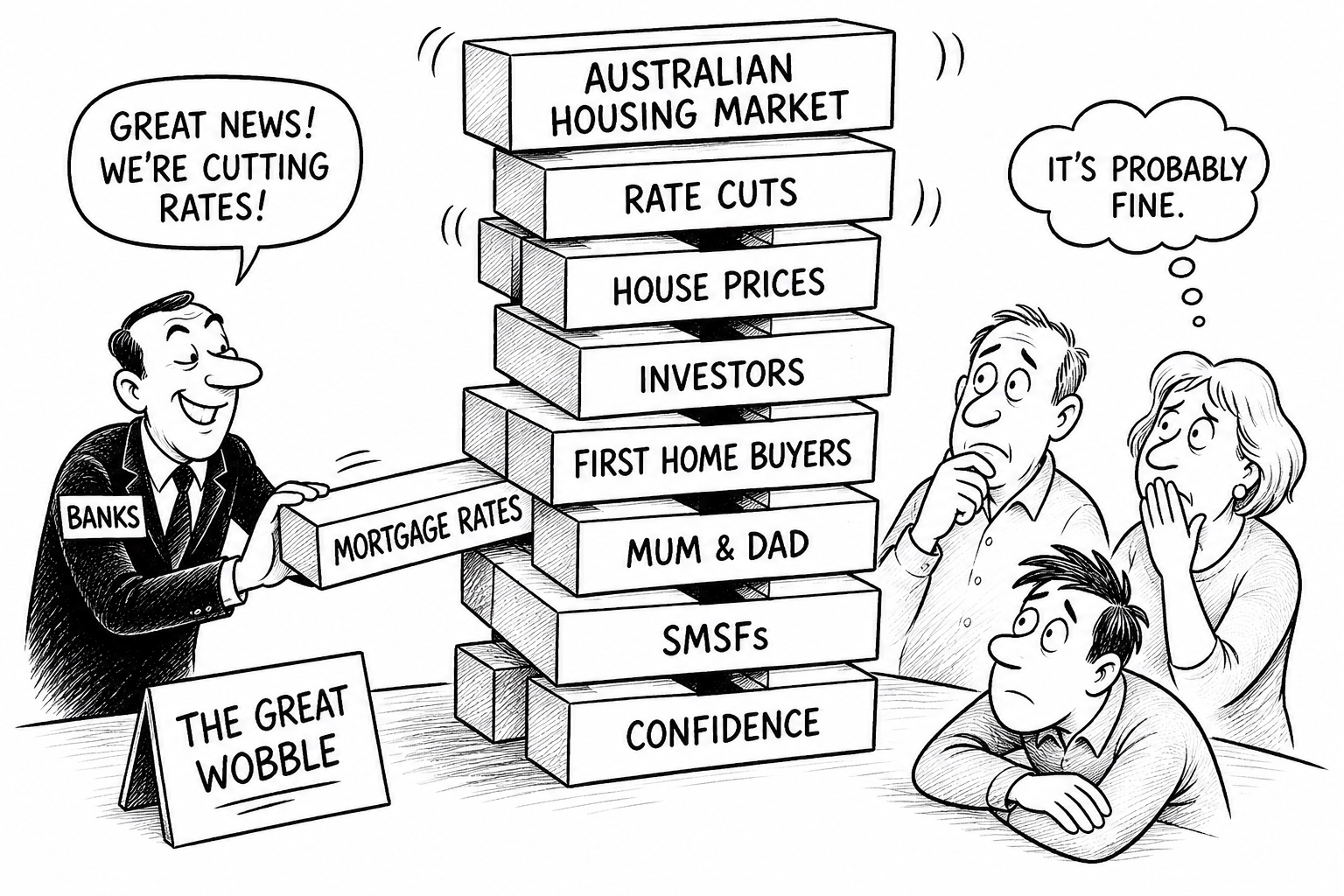
Rates are falling, prices are wobbling, parents are heading for the hills. None of it is a crisis yet — but it’s the kind of week where a lot of separate small nerves start looking like one big one.