
The Tax Magician
A magician walks to centre stage. The audience cheers.
Magician: “Ladies and gentlemen, boys and girls. Tonight’s spectacular illusion. Watch closely. You will see there is nothing up my sleeve. I present a company! It generates $8.3 billion in income. But wait. Where’s the income tax?
A loud explosion and a puff of smoke engulfs the stage
Magician: It’s gone!
Crowd : Gasps!
Magician: Another company. It generates $9.7 billion. The tax?
More noise. More smoke
Magician: Gone!
Crowd falls silent. Some exchange puzzled looks. A small voice can be heard.
Child: Mummy, can we make our tax disappear too?
Mother: No darling, we are not a multinational.
Magician raising his voice: A third company $2.3 Billion of income! He shouts: Deductions, Offsets & Related-Party Payments!!!!
Explosion. Smoke.
Magician: The tax has gone!
He peers at the crowd expecting applause.
First voice: That’s not magic.
Second voice: That’s accounting.
Third voice: Arsehole!
Magician. Quickly: Don’t try this at home. Australian households are not permitted to make their taxable income disappear.
Crowd jeers. Curtain falls. Magician makes a hasty retreat.
As they say on the tele, this play is based on real-life events. It comes to us courtesy of the Australian Tax Office which, each year, publishes the tax information of companies that generate at least $100 million in Australian income.
In 2024-25 more than one-quarter of these companies paid no or little corporate tax in Australia. Microsoft, Netflix, Adani Mining, Sony Australia and Kogan are among the lucky winners.
There is no suggestion that any of these companies are breaking the rules. What we are suggesting is that when a company earns billions of dollars in Australia and pays bugger all tax on it, then the rules need fixing. Now, that would be magic. Read the detail at The Guardian
The Rate Rise Has Arrived. Again.
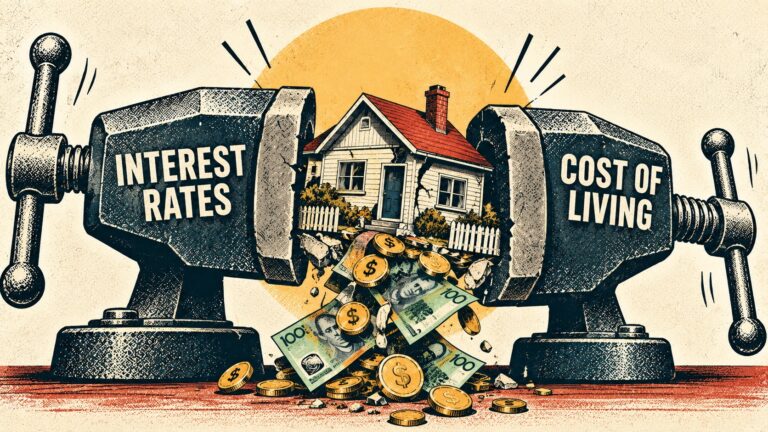
All of the big four banks have now passed the RBA’s latest 0.25 percentage point increase on to variable-rate borrowers. From October 9, Westpac’s lowest variable rate will rise from 5.99% to 6.24%, while the other three majors will start between 6.29% and 6.50%.
That means the last big-bank variable mortgage rate beginning with a 5 has disappeared.
And November is now the next instalment of the guessing game. Westpac and ANZ expect another increase, while CBA and NAB expect the RBA to hold. The RBA will have September CPI and labour force figures in hand before its 2–3 November meeting.
While the banks have generously given borrowers at least 20 days’ written notice it’s small consolation if your household budget is already held together with sticky tape. Read more at Broker News
The RBA’s Rear View Mirror
The RBA’s October Financial Stability Review says most households with mortgages remain well placed to cope with tougher conditions, even if house prices fall sharply, while most businesses should manage elevated costs. Australian banks, it says, are well positioned to continue lending through a downturn.
That’s the reassuring bit. The less reassuring argument comes from Michael Pascoe writing for Michael West Media. If you like a contrarian viewpoint, you will find it here. He takes issue with the bluntness of monetary policy and accuses the RBA of incompetence. He says that higher rates hurt heavily indebted households while benefiting people with cash and some fixed-income investments. In other words, the rich get richer while the not-so-rich struggle.
Asic Discovers the Referral Program
ASIC has warned banks that it’s investigating how they use and pay referrers. The probe is expected to begin in the third quarter of the financial year. Referrers are generally professionals, like accountants, who receive fees for referring clients to a lender.
The timing is interesting because the mortgage industry has spent much of 2026 dealing with an expanding fraud scandal. CBA initially reported suspected fraud of about $1 billion. AUSTRAC subsequently ordered 10 banks to provide mortgage data, and reported estimates of the suspected fraud later grew to $2 billion and then $3 billion.
Of the big four, CBA and Westpac still operate introducer programs, while ANZ and NAB shut theirs down years ago.
Look Rich, Pay Later
Social media appears to have created a new asset class: looking wealthy while being stony broke. You’ll find representatives of this young crowd hanging out on Instagram or TikTok engaging in displays of wealth that are a total fantasy. Luxury holidays, designer clothes, expensive restaurants, cars and an endless parade of products are all being turned into “content” for this look-at-me-generation while buy-now-pay-later and credit card debts mount. No doubt the bank of mum and dad will pick up the bill.
In an article that just as easily could have been written about Australia, John Mac Ghlionn, writing for The Hill documents the phenomenon in a piece called, United in Debt: America has become a nation of fake rich people.
IN CASE YOU MISSED IT……
MORTGAGE PRISON GETS CROWDED:
Finder’s 2026 Home Loan Report says 55% of mortgage holders spend more than 30% of take-home pay on repayments, while 44% expect to still have a mortgage when they retire or already do. Read more at Finder
WESTPAC SEES A HOUSING HIT
Westpac has doubled its forecast for the national fall in house prices this year from 3% to 6%, with a peak-to-trough decline of 7.3% now forecast and Sydney tipped for a 10% fall. Read more at realestate.com.au
LESS BUILDING, MORE PROBLEM
Australian dwelling approvals fell 6.1% in August to 16,953, with apartment approvals particularly weak as the country tries to build 1.2 million new homes by June 2029. Read more at Australian Conveyancer
MONEY WITHOUT BUSINESS HOURS
ANZ has trialled tokenised deposits through Swift’s blockchain ledger, allowing BHP to make a US-dollar payment between Melbourne and New York while using its existing banking arrangements. The ambition is simple: move money around the world without waiting for the banks to open. Read more at InvestorDaily
Stay Sceptical. Question Everything. Ignore the marketing department.