The market’s back, baby. Until lunch.
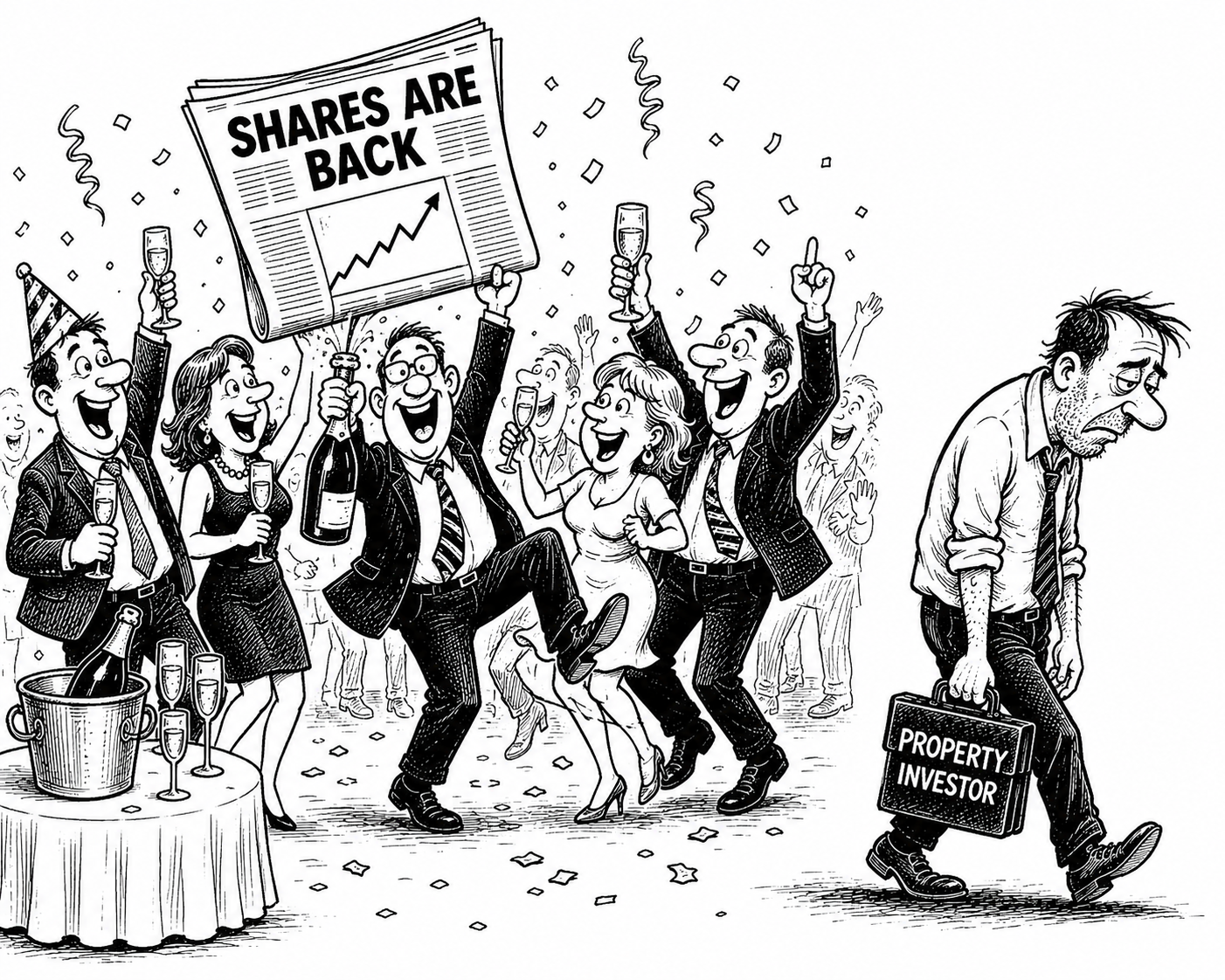
The Australian sharemarket has just had its best day in six weeks because traders suddenly decided maybe the economy isn’t being fed into a woodchipper after all. Rate hike fears eased, bank stocks bounced, and investors briefly remembered that panic attacks are exhausting.
Banks rallied, miners climbed, and everyone pretended this wasn’t the same market that was screaming into a pillow a fortnight ago. Investors are now clinging to every inflation number like medieval peasants reading goat entrails.
But housing? Oh boy……
A growing number of economists are forecasting falling house prices, including predictions of declines up to 10 per cent. Which in Australian property terms counts as “basically Armageddon”.
Among other things, the cracks are appearing because mortgage costs have reached the point where even wealthy couples with matching white sneakers and an investment podcast are starting to sweat.
Economists are warning that borrowing power has been smashed by higher rates and changing lending conditions. Amazing discovery: if people can borrow less money, they tend to offer less money. Revolutionary stuff. Somewhere, an economist is polishing a Nobel Prize made from recycled avocado toast.
Banks kneecap investors
Banks are reportedly cutting borrowing capacity for property investors by around 20 per cent in response to changes around negative gearing and lending rules. Which means many would be landlords have gone from “maybe a townhouse” to “strong emotional attachment to Gumtree caravans”.
This is the bit politicians never mention. Housing markets don’t just rise because people want homes. They rise because banks create industrial quantities of debt and spray it through the economy like confetti at a divorce party. Reduce the credit flow and suddenly the market starts behaving like a normal asset instead of a crypto cult with landscaping.
Borrowers now face the brutal arithmetic of higher repayments and stricter lending standards. The banks, meanwhile, continue describing this as “responsible lending” after spending two decades handing out debt like supermarket sample trays.
First home buyers briefly experience hope
While Investors are pulling back from the property first-home buyers are experiencing a rare and mystical thing known as “a chance”.
Until now, the market has been so saturated with leveraged landlords that first-home buyers have spent years bidding against people whose retirement plan consisted entirely of owning four fibro boxes in Whoop-Whoop.
CBA: The $300 share that apparently might not be
Brokers are now debating how low Commonwealth Bank shares could go after their extraordinary run-up. Which is finance-speak for: “We may have slightly overdone the whole untouchable profit machine thing.”
For years CBA has traded like investors believed it was protected by divine intervention and several divisions of the Australian Army. But analysts are now warning valuations may have drifted into fantasy territory.
The amusing part is that every broker suddenly rediscovers caution after the stock has already spent years climbing like a caffeinated mountain goat. Financial analysis often resembles weather forecasting performed after the hurricane.
Zip finally wins something
Zip Co has settled its trademark stoush with Firstmac and locked in the rights to keep using the Zip name in Australia. Which, for a buy-now-pay-later company in 2026, probably counts as a pretty decent week.
The dispute was resolved after Zip acquired the trademark, sidestepping a decision in the Federal Court which determined the Firstmac actually owned the name. That’s good news for a sector that’s already spent the past couple of years discovering that easy credit becomes a lot less fashionable when households are struggling to pay for groceries and electricity at the same time.
There was a time when fintech companies could lose money hand over fist and still call it “growth”. Those days are over. Now the market wants actual earnings, sustainable business models and the occasional sign of adult supervision which has come as a huge shock to the tech bros.
The wrap
So to summarise: the sharemarket is euphoric because inflation might slow, the housing market is wobbling because debt finally costs money again, banks are pretending tighter lending is noble, and investors are discovering property speculation carries risk after all. Australia’s economy remains what it has always been: a highly leveraged real estate convention briefly interrupted by moments of accidental productivity.